Bible Seminar | Pastor Dr Christian Gossweiler
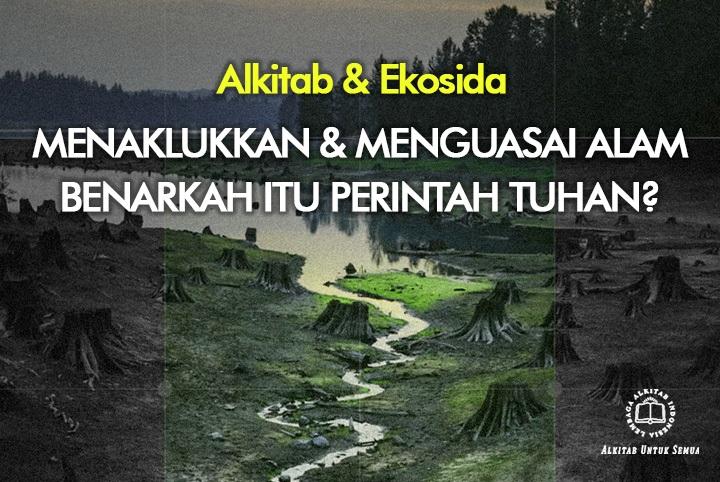
In the last few decades, awareness of the importance of protecting the environment has grown stronger. Various commemorations such as Earth Day and Environment Day remind humanity of its responsibility towards the earth. In this context, a reflective question arises: what exactly is the contribution of the Christian faith to the preservation of nature?
It is not uncommon for Christianity to be seen as less environmentally friendly. There is an assumption that when humans no longer see nature as sacred, no longer believe in the existence of spirits in trees or animals, then nature becomes an object that is freely exploited. On the contrary, some local beliefs are considered to be more respectful of nature because they maintain a respectful relationship with the living beings around them.
In the midst of these questions, it is important to go back to the Bible. Is it true that the Bible only talks about the salvation of human beings? Or does it also contain good news for the whole of creation, including animals, plants, and all creatures?
Creation as God's Good Work
The biblical witness begins with a fundamental confession: the world is God's creation. In the creation account (Genesis 1-2), the whole of creation: heaven, earth, plants, animals, and humans, is presented as God's good work. In fact, in the end, it is declared to be “very good.This recognition is important because it confirms that the value of creation does not lie solely in its usefulness to human beings, but in the fact that it comes from God and is in relationship to Him.
This image continues to appear in various parts of the Bible. The promised land is depicted as a land flowing with milk and honey, a symbol of the abundance and fertility that God bestows. The psalms often invite the people to see creation as part of God's praise: trees, birds, and even young lions are described as living in dependence on Him.
In the eschatological vision, the Bible even paints a picture of the complete restoration of creation. The tree of life bears fruit continuously, and its leaves bring healing. Animals that previously preyed on each other are depicted living in peace. All of this shows that from beginning to end, the Bible views creation as a meaningful part of God's work.
When Sin Damages Relationships with Creation
However, the testimony of the Bible does not stop at the beauty of creation. Since the fall of man in sin, the relationship between man and creation has been damaged. The once fertile soil became difficult to cultivate. It produces thorns and thistles. Subsequent stories show that man's violence also affected the earth. The land became "cursed," and life no longer took place in harmony.
The prophets emphatically voiced the connection between human sin and the suffering of nature. When humans live in unfaithfulness, it is not only society that suffers, but also the animals, birds, and even the fish in the sea. The whole of creation feels the impact of man's moral decay.
This image is very relevant to the current situation. The environmental damage that has occurred in various places reminds us that human sin is never individualised. It has far-reaching, even cosmic repercussions.
Good News for All Beings
In the midst of this reality, the Bible presents hope. One important text to note is the mandate in Mark 16:15, “Go into all the world and preach the gospel to every creature.” The phrase “every creature” indicates a wide scope. The gospel not only speaks of the salvation of human beings, but also of the restoration of creation. This is in line with other New Testament testimonies.
In Colossians it is affirmed that all things were created in Christ and reconciled through Him. Meanwhile, in Romans 8 it is described that the whole creation is "groaning" and waiting for deliverance. Creation is portrayed as longing for God's promised restoration.
Thus, the gospel has a cosmic dimension. It speaks of God's work of restoring not just human beings, but the whole of creation.
The Gospel has a cosmic dimension.
Old Testament Testimony to the Restoration of Creation
This understanding is actually rooted in the Old Testament. After the flood, God made a covenant not only with humanity, but also with all living creatures. This suggests that God's relationship with creation is comprehensive.
The prophets also expressed hope for a future in which the relationship between humans and nature is restored. The image of peace between the animals symbolises a renewed world. Thus, from beginning to end, the Bible displays a common thread: creation came from God, was broken by sin, and will be restored by God.
.
The Church's Mission in the Wholeness of Creation
This awareness of the broad scope of the gospel encourages the church to reflect on its calling. The mission of the church is not only concerned with people, but also with the whole of creation. The theme of the renewal of the whole creation is getting more and more attention. Churches are beginning to realise that preaching the gospel also means taking part in caring for the earth.
In Indonesia, this reflection can be seen in various ecclesiastical documents that emphasise environmental responsibility. While initially the understanding of mission still tended to be human-centred, it is now increasingly recognised that the gospel must be good news for the whole of creation.
Living the Faith in Environmental Stewardship
The next question is: how does this translate into everyday life? The Bible gives a simple yet profound clue: the righteous man cares for his animal life. This means that the relationship with God is inseparable from the way man treats creation.
In practice, this concern can be realised through various concrete steps. Reducing the use of plastic, preserving nature, using energy wisely, and building environmental awareness from an early age are all part of the responsibility of faith. These actions may seem simple, but they have deep theological meaning. Through such actions, believers take part in God's work of preserving and restoring creation.
Closer
In the end, the Bible sets our sights on a hopeful future. There will come a time when all of creation is restored, lives in peace, and together glorifies God. In the light of this hope, believers are called to live as witnesses of the gospel. Not only to fellow human beings, but also to the whole of creation. The gospel is still addressed to man as the centre of proclamation, but its impact does not stop with man. It reaches out to all of life.
Thus, the Christian faith does not contradict environmental concerns. Rather, it provides a solid foundation for caring for the earth as part of God's “truly good creation.”
Let us all be enabled to be more creative in preaching the gospel to all creatures. The gospel is still preached to men, so that more and more people are won to the Lord Jesus and believe in Him. But, at the same time, may the animals and plants around us also feel the blessing of the good news.
(Rev. Dr Christian Gossweiler)