People often mention the name H.A. Pandopo. Written as the author of many congregational hymns in songbooks: Kidung Jemaat (KJ), Nyanyilah Kidung Baru (NKB) or Kidung Keesaan (KK). Who is he? From his name, many people think he is Javanese. But he wasn't.
Pdt. Em. Hermanus Arie van Dop, known by his pen name H. A. Pandopo, was a Dutch pastor, theologian, and church music maestro who dedicated more than 40 years of his life to the development of liturgy and congregational singing in Indonesia. Born in 1935 and passed away in 2026, he was one of the architects behind the compilation of cross-denominational (ecumenical) songbooks, such as: Kidung Jemaat, Complement to Kidung Jemaat, and most recently Kidung Keesaan.
Through academic rigour and a love of local culture, van Dop successfully blended the treasures of Western music with the cultural breath of Indonesia. His dedication was not only limited to the creation and translation of thousands of ecclesiastical songs, but extended to the world of theological education and the preservation of the hymnological tradition, making him the "Father of Indonesian Psalms", whose services continue to resonate across generations.
Early Life
Hermanus Arie van Dop was born on 28 May 1935 in the Netherlands. From an early age van Dop showed a strong interest in church music, especially congregational singing and its accompanying instruments. When he was in his teens, his musical interests expanded. He became interested in ethnic forms of music and singing. As time went on, his attention to the liturgical aspects of the church also grew, laying a strong foundation for his expertise as a future hymnologist.
Education and Character Building
To prepare for his call to ministry, van Dop pursued a formal theological education. After that, he studied ethnomusicology and missiology at the College of Missiology in Oegstgeest (Zendingshogeschool Oegstgeest), the Netherlands. His interest in Indonesia was nurtured early on, and he even wrote a thesis dissecting Bugis-Makassar folk music based on the literature in his alma mater's library.
It was also at the library that the young van Dop met the Reverend I.S. Kijne, compiler of the book Psalms & Hymns. This encounter fuelled van Dop's critical thinking. One day, van Dop asked why there were no songs with an Indonesian cultural flavour in the book. Pastor Kijne responded to this critical question with displeasure. Despite the cold reaction, van Dop was not disappointed. He only understood the complexity of the reasoning behind Kijne's attitude years later, when he himself became directly involved in the compilation of the Indonesian songbook.
Van Dop's unique character as a person who was one with music is clearly recorded in the memory of his colleague, Andar Ismail, while studying with the Hendrik Kraemer Instituut in Leiden, Netherlands in 1965. In the dormitory van Dop occupied the room opposite to Andar's.
“ Whenever we walked together to the dining room three times a day, van Dop always walked with a look on his face and all his limbs moving rhythmically, ” Andar recalled. ” His body moved lively as if he was enjoying a grand musical composition in his head, even though the surrounding atmosphere was very quiet, ” he continued.
To those around him, van Dop was a "being of suluk"; a person whose entire heart, conscience, soul, and body were completely merged with song, rhythm, and music.
Service and Career Journey
Van Dop's ministry journey in Indonesia began in 1967, when he was sent as a zendingspredikant (missionary pastor) to South Sulawesi. His missionary territory included Malino and Makassar. There, his ethnomusicology knowledge flourished through travelling to the regions of Gowa, Soppeng, and Selayar Island to research regional music and mingle with the people.
It was while serving in South Sulawesi that he recalled Kijne's book, Psalms and Hymns, which many mainstream churches use as worship songs. Van Dop discovered that Kijne had deliberately left out the names of the original lyricists and songwriters, so that the Western origins of the songs would not be immediately obvious to local congregations. And so van Dop began his historical literature project, he was moved to compile a complete list of the names of the original composers for the sake of educating the history of ecumenical theology in Indonesia.
In this quest, he received help from Rev Mathindas in Makassar who gave him two thick volumes of original chant collections by Rev H. Hasper. This Dutch-language book contained 400 hymns with full hymnological notes, including the hidden original names of the authors. This discovery became his main asset in tracing the sources of church hymnals from various European countries and the United States.
In 1972, van Dop relocated to Jakarta after being appointed as Lecturer in Theology, Liturgy, and Church Music at the Jakarta College of Philosophy (STFT Jakarta). Alongside his role as lecturer, he also became one of the founding figures and prime movers in the Church Music Foundation (Yamuger). During his time in Jakarta, the Yamuger office in Rawamangun, East Jakarta, became his workplace as well as his daily residence.
At Yamuger, van Dop built close collaborations with his close friends and fellow church music writers, such as M. Karatem and Soebronto K. Atmodjo, a talented composer who had been detained on Buru Island. This ecumenical togetherness continued until he entered emeritus as a pastor in 1997. Despite being a retired lecturer, his ministry activities in the field of music never faded.
Contributions and Impacts
The real contribution of van Dop during his 40 years of work in Indonesia was massive. Together with colleagues from various ethnic groups in the archipelago, he created, composed and translated thousands of church songs across denominations. He acted as one of the main architects behind the compilation of Kidung Jemaat (KJ), Pelengkap Kidung Jemaat (PKJ), and Kidung Keesaan.
His impact also extends to the historical ecumenical theological realm through his persistence in maintaining the tradition of singing the Geneva Psalms in Indonesia as the historical roots of ecumenism. For his dedication, a national spiritual magazine gave him the honourable title of "Father of the Indonesian Psalms."
Outside the field of music, van Dop's academic rigour manifested itself when he translated the scientific-theological book The Evolutionary Doctrine and Christian Faith by Rev. C. Petri in 1987. To ensure the accuracy of scientific terminology, he specifically sought the help of Mr B. Galstaun, director of the Ragunan Zoo, to harmonise the zoological terms into standard Indonesian. This co-operation is noted with great respect by Rev C. Petri in the preface to the second edition of his book.
Challenges and Struggles
In building the music literacy of Christians in Indonesia, van Dop is often concerned about the fundamental weaknesses of Indonesian congregants and pastors. Many congregants and pastors are unable to read music notation, so high quality songs are rarely sung correctly or even ignored. An example of this is the book Nyanyilah Kidung Baru (NKB); although it has great theological and literary weight, many of the songs are silent and rarely used in worship because the pastor cannot give an example of singing them. Take for example the African-influenced song in NKB 72. As a solution, van Dop continues to encourage the presence of a proctor (song leader) in every congregation to train people to sing properly.
Not many people know that the key to van Dop's entire treasury of 19th-century hymnological knowledge came not from a fancy library, but from the flea market and book sale of Gunung Agung in Jakarta. There, he rescued two thick volumes of the super-rare 1,768-page John Julian's Dictionary of Hymnology at a bargain price. This flea market book became one of his pillars of academic reference in Indonesia.
In the selection and drafting process of the hymnbook manuscripts, Mr van Dop was known for his unwavering commitment to the theological purity of the song texts. This often creates a unique tension in the Yamuger boardroom. When dealing with new song submissions from local songwriters, Pak van Dop is known to be very strict, detailed, and uncompromising. His friends at Yamuger often joked about his extreme theological rigour. Pastor Yoel Indrasmoro, a former student and colleague, uses Javanese terms to describe Pak van Dop's theological acumen. He was waskita (wise, broad-minded) and weruh sakdurunge winarah (knew before it actually happened).
Mr van Dop's precision is so sharp in detecting and correcting dogmatic errors or theological flaws in the lyrics of a song. Even before the errors or incidents in the lyrics have been written down or fully composed by the songwriter. It is this visionary decisiveness that keeps the quality of the Song of Songs strong in theological meaning. It is this meticulous and determined attitude that has been continued by his successors in Yamuger until now.
Legacy and Influence
Pak van Dop left a lasting legacy of neatly and precisely handwritten manuscripts of Psalms and hymns. In the eyes of his students and academic colleagues, such as Rev Prof Joas Adiprasetya, Pak van Dop is remembered as the "empu hymn Indonesia" who bequeathed invaluable harmony of faith to the churches in Indonesia.
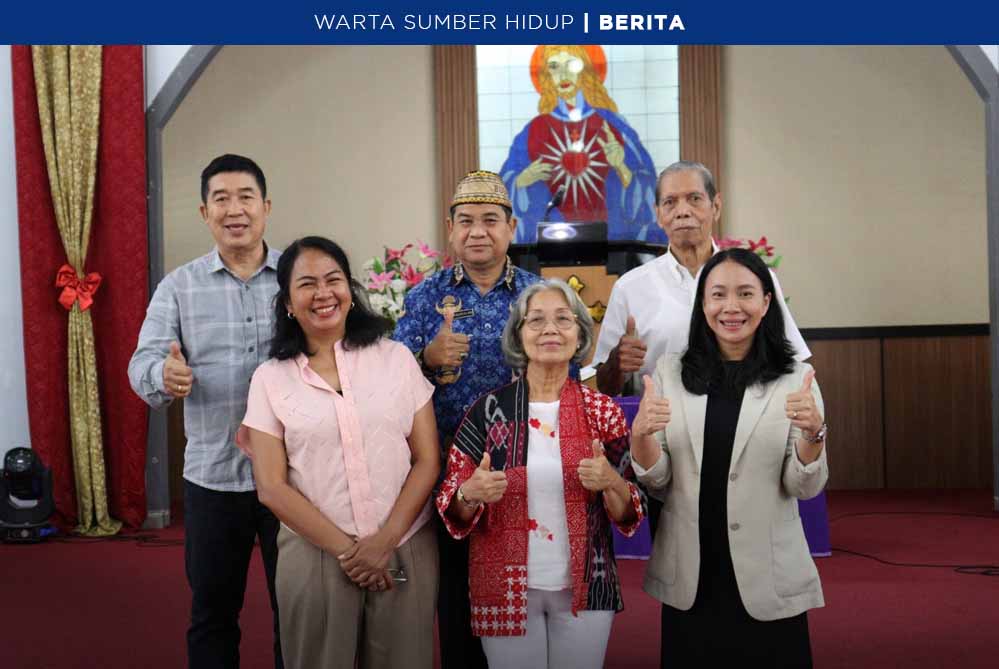
In his twilight years, Rev van Dop spent his old age in an apartment in Amersfoort, the Netherlands. On the occasion of his 90th birthday, the worship space of GPIB Paulus in Jakarta was connected via a virtual bridge directly to his residence. During this moment, he did not talk about his monumental works, but showed genuine hospitality without barriers. He was touched to see friends, asked how they were doing, thought about the scarcity of orgel technicians in Indonesia, and asked where to get young jackfruit in the Netherlands to make the original Gudeg Jogja.
On 31 May 2026, the architect of hymns breathed his last at the age of 91. Rev Hermanus Arie van Dop was a European figure who came to the archipelago not with cultural pride. He came as a friend and a bridge, so that the music and culture of the archipelago that coloured the worship space of the congregation, taught the church to live humanity and friendship across the distance of time and culture. (perlando).