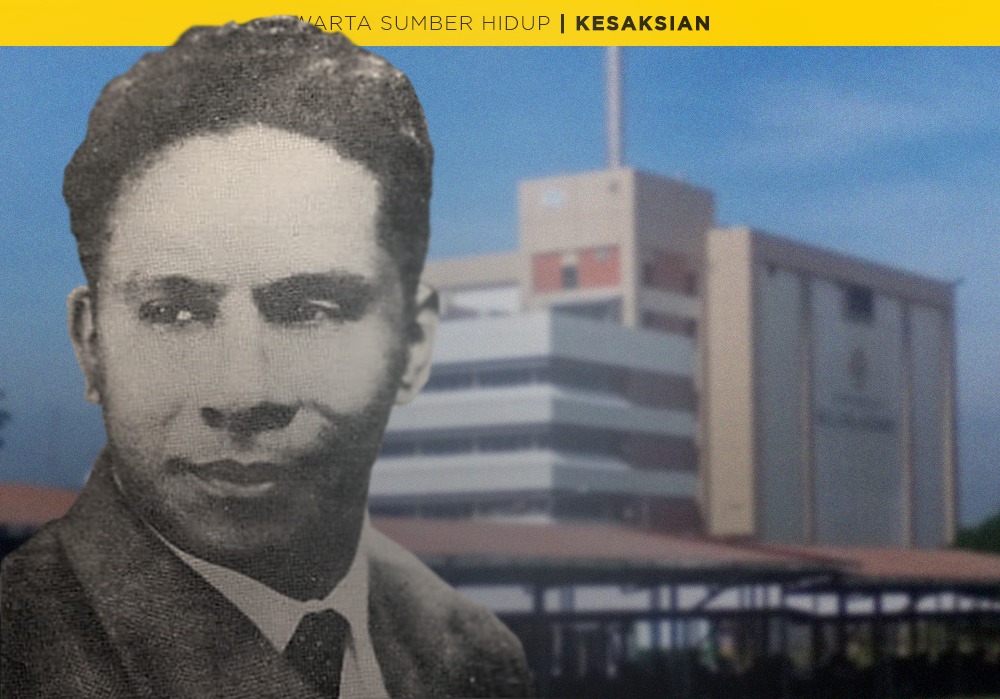
“God, make me holy, but not now.
Augustine was born in Thagaste – now Algeria – in 354. His mother Monica was a devout follower of Christ, while his father Patricius was a pagan, Roman official. Growing up, Augustine began to disobey his parents and became a little wild. There was a time when Augustine and his friends in the group "7 Challengers of Thagaste" stole pears belonging to a poor farmer and threw them to the pigs.
Despite his mischievous behaviour, Augustine was known as an intelligent boy. Because of his intelligence Monica and Patricius sent Augustinus to the best schools. He learnt rhetoric in Carthage and read the works of Latin writers such as Cicero. Holding on to the conviction of what he learnt, that truth is the goal of life, he initially rejected Christianity. According to Augustine, Christianity was a religion for fools.
As he grew older, his mischief became more and more severe. Monica could not do much to prevent Augustinus' delinquency. She tried to give him all the advice she could. On the other hand, her husband, Patricius, never set a good example as a father to his children, especially Augustinus. According to Patricius, it doesn't matter that Augustinus is naughty, the important thing is that he is smart and famous.
One day Monica received news that made her even sadder. Augustinus had a girlfriend and she was pregnant. Every day Augustinus went on a spree. Augustinus didn't want to go to church anymore. Recalling his wild days in Carthage, Augustine wrote in his book ConfessionsThus, ”I came to Carthage, where I was plunged into the fiery scene of lust.”
Monica was sad. She often confided in her pastor. The priest always tried to strengthen Monica, he said, "A mother's prayer is heard by God." Another time the priest advised, "A mother's tears are not in vain, Christ weeps with a mother." The priest assured Monica thus, "The child will surely be saved, because it has caused the mother's tears to be drained.
Augustinus continued to struggle in his search for true truth. This turbulent young man once tried Manichaeism, which taught that the world was a battleground between light and darkness, flesh and spirit. But Manicheism failed to satisfy his desire for true truth. So it was with the philosophy of Neoplatonism. In the eyes of many Augustine was increasingly successful. At the age of 29 he was already professor of Rhetoric and Dialectic in Rome and later in Milan. His position was very good. However, his heart drifted further away from God. He wanted to show that his success was not a gift from God, but the result of his own labour. His income was so great that he no longer depended on his mother's remittances. He sent less and less news to his parents, saying that he was busy.
One day someone gave Augustine a book. It was by Ambrose, Bishop of Milan. Augustine read it and was enamoured with its contents. He said, "Eh, it turns out that not all Christians are fools!
When Augustine was sitting in Milan in 387, he heard a little boy chanting, "Take and read; take and read." Augustine read what was nearby: Paul's letter to the Romans. As he read Romans 13:13-14, Paul's words about putting on the Lord Jesus as armour of light and not treating the body to gratify lust struck a chord in his heart. Little by little Augustine began to repent.Confessions, Augustine wrote of the moment thus,”It was as if the light of faith filled my heart and all the mist of my doubts was dispelled.”
Augustine began to listen to sermons and often had discussions with Bishop Ambrosius. Augustine's heart began to melt. He read and pondered the letters of the Apostle Paul and the books of the 2nd century Church Fathers. Augustine began to realise that he had been nurtured by his mother from the womb, through childhood and into adulthood. He recalled his mother's advice and example when he was in Thagaste, North Africa. He also recognised that he was a sinner who had been embraced by Christ to obtain salvation. Soon Monica followed Augustinus to Milan. How happy Monica was when she learnt of Augustine's conversion. Years of prayers and tears poured out for Augustinus, finally got an answer from God.
Augustine received baptism ministered by Bishop Ambrosius on Easter Day 387 at the ripe old age of 33. Not long after, Monica died. However, she passed away in peace, as Augustine decided to devote himself fully to God.
In 388, Augustine returned to Africa. There he sold his possessions and distributed them to the poor. Together with a number of his companions, he founded a religious community. They devoted themselves to the study of the Bible and the work of the hands. Day and night Augustine studied biblics, theology and pedagogy. Augustine also began to write a lot. Although Augustine was content with his life as a monk, his reputation as a brilliant Christian theologian quickly spread.
In 391, Augustine came to Hippo, at the invitation of a high official who was interested in Augustine's way of life and his community. Hippo was the main port on the North African coast after Carthage. It had a population of about 40,000 and was situated at the mouth of a river, in the middle of a fertile agricultural area and with a harbour protected from storms and large waves. Because of the traffic of merchant ships, the city had many international connections. The local bishop, Valerius, was from the eastern part of the Roman empire and spoke Greek. His ministry was plagued with endless arguments with the Donatists. The Donatists were named after their bishop Donatus, who lived in the first half of the fourth century. The Donatists claimed to have refused co-operation with the Roman authorities during the great persecution of Emperor Diocletianus (303-305). At that time, there were bishops who were more flexible for the sake of the people, as they were, for example, willing to hand over the Church's books when state agents came to confiscate them. Thus, a difficulty arose, because the Donatists did not want to recognise the validity of the office of bishops and priests who had behaved in this way. The difficulty was not overcome and the church in Africa began to fracture. The Donatists were convinced of the correctness of their opinions and constantly challenged their opponents to a debate. Bishop Valerius was not well versed in Latin, which in North Africa was the lingua franca. He was therefore looking for someone who could assist him. Augustinus, who had come to visit, saw fit to become his assistant.
Against Augustine's own wishes, the congregation urged him to agree to become a priest. They brought him before the congregation and soon Valerius ordained him as presbyter(priest). As was customary in the churches of the eastern part of the empire, the old bishop told his new priest to preach. However, in the western churches this custom did not apply. In North Africa in particular, it was the bishop who presided over the ceremonies and preached the sermons. So, Augustine made an unusual request. He asked for a year's leave to prepare himself through Bible study. It wasn't until 392 that he was confident that his knowledge of the subject was sufficient for him to preach the Word in the Catholic Church. From that year, for almost 40 years, Augustine preached every Saturday and Sunday, at every feast day service, and at times even every day, several times a day.
Back to the debate with the Donatists, Augustine rejected the existence of a counter-church. Though there were few saints in the church, he said, the Church was one. Sacraments, which Augustine said were visible signs of invisible grace, were not effective because of the virtue of the priest, but because God's grace worked through the sacraments. The Church is holy because it is the Church of Christ, Christ's own. Augustine's view prevailed and Donatism eventually became extinct.
As mentioned earlier, Augustine not only wrote sermons and opposed heresies, he also wrote his own spiritual journey in his book Confessions, which may be the first spiritual autobiography. The famous sentence,”Our hearts are restless until they rest in you” comes from its opening paragraph. When the Bishop of Hippo died in 396, Augustine succeeded him. He continued to serve as bishop of Hippo until his death in 430.
Because Augustine's teachings were so fundamental to Christianity, we do not realise how original Augustine was in his time. His thinking has permeated both Catholic and Protestant theologians. Even Luther and Calvin often quoted his statements. They favoured Augustine's emphasis on God's grace and man's inability to save himself.
Augustine wrote hundreds of treatises, letters and commentaries. Augustine's works still recorded today comprise 600 sermones(sermon), ada 124tractatus(description) of the Gospel of John, 10tractatuson the First Epistle of John. Furthermore, there are about 205 enarrationes(in-depth analyses) of the Book of Psalms. Beyond that there are other expositions (singular exposition, exegetical explanation). Some of his books are so well known even today.
In addition to Confessions(Confessions) which contain an autobiography of his faith, his classic work De Trinitate(On the Trinity) is probably one of the best works on the theme. However, many theologians call his most important work De Civitate Dei(City of God), a monumental work on the fall of Rome to the Visigoths. Many people think that Rome fell because its people had abandoned their native gods. The gods were angry that they were no longer being worshipped. They then blamed the Christians. So Augustine responded by defending and explaining God's plan and work in history. Since Cain and Abel, he said, there have been two cities in the world: The City of God (the faithful) and the Earthly City (the unbelievers). He wrote “The two cities have been formed by two loves; the earthly city by the love of self that leads to the humiliation of God, and the heavenly city formed by the love of God that leads to the neglect of self. In the one city the rulers and the conquered nations are ruled by the love of power. In the other city the rulers and the people serve one another in love, the people by obeying and the rulers by caring for all….These two cities are two forms of human community. The one is destined to reign with God forever, the other to suffer eternal punishment with the Devil…The citizens are born into the earthly city by nature corrupted by sin, but they are born again into the heavenly city by grace which liberates nature and sin (De Civitate Dei/City of God 14:28-15:2).
Augustine died in 430, as barbarian armies prepared to attack the city of Hippo. Western Roman civilisation began to fall apart. But in De Civitate Dei, Augustine had taken classical culture and transformed it into a new Christian culture. This work became one of the greatest works of the early church. In many ways, its content underpinned and became the framework for the theology and thought of the Middle Ages.
Augustinus' contributions were the fruit of Monica's tears and prayers. Without Monica's tears, the church might not have had Saint Augustine. Hence, church history honours Monica as an icon of maternal intercession. Monica is synonymous with mother's prayer. She is the symbol of all mothers who pray every night for the safety and well-being of their children. She is the epitome of the mother who waits for her children to come home and return to the right path.
Like St Augustine, we are all well and prosperous today thanks to the support of our mothers' prayers. How true, then, are the lyrics of the song, "In my prayers my mother hears, there's my name mentioned"?
Library
Tony Lane. Runtut Pijar. BPK Gunung Mulia.
Kenneth Curtis, et al. 100 Key Events in Christian History. BPK Gunung Mulia.
Andar Ismail. Happy Confession. BPK Gunung Mulia.
Roy Soselisa. A Mother's Prayers and Tears Save Her Child. Article in kompasiana.com.
Austinus David Mahardika. Exploring the Life Example of Saint Augustine, Repent and Return to God. Article in kompasiana.com.