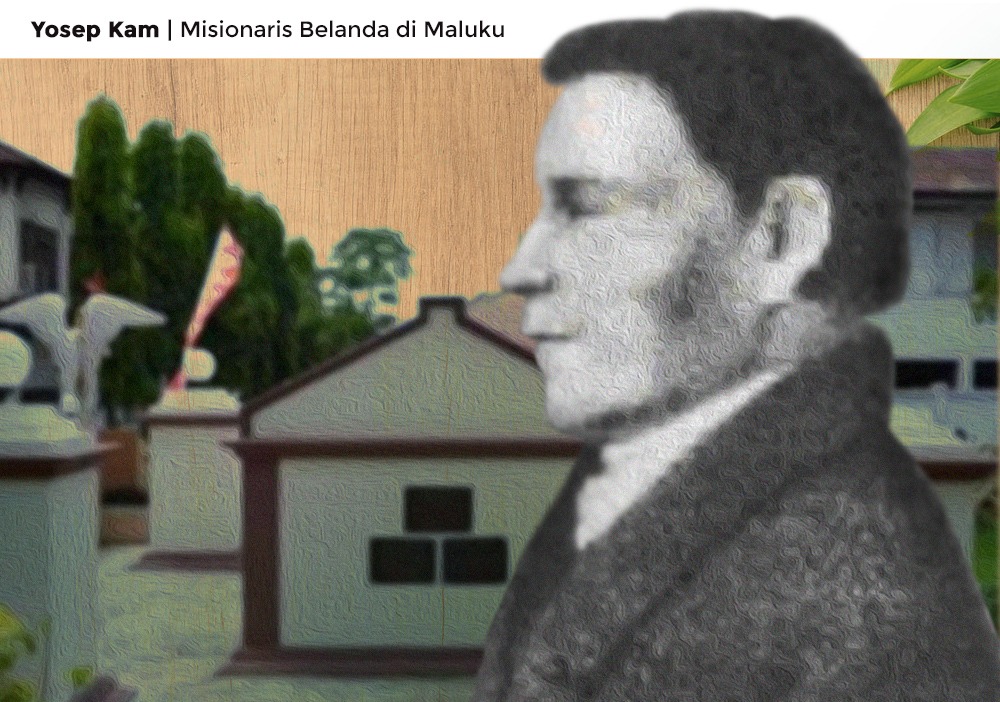
Joseph Kam: “I am now studying God's will and ways. I want to become a missionary.”
The preaching of the Gospel to the people in Maluku had already been carried out by Francis Xaverius in the 15th century. And then the Dutch Zendeling Genootschap (NZG) entered in the 18th century and succeeded in baptising thousands of Moluccans into the congregation of the Protestant Church in the Dutch East Indies (GPI). Since then Amboina has been known as a church lover, Bible lover, especially the Book of Psalms. If you walk down the streets and alleys in Ambon at night and it is quiet, you can often hear church singing in houses. Or, on another night, you can hear a father saying night prayers in a loud, heavy voice for his own family and the families of his neighbours. Then during Sunday worship they sit neatly and reverently. In the worship activities there, the pastors available at that time served mostly European members of the congregation. The Moluccans were only provided with a few pastors plus teachers and elders. Until then came Joseph Kam who could not bear to see thousands of Moluccan Christians lacking spiritual care and then encouraged mission agencies to pay more attention to the Moluccan people because so far the spiritual care of the Moluccan people was only a side job of the pastor.
In his humble home in Hertogenbosch, Netherlands, Joseph Kam was born in September 1769. Joseph was the son of Joost Kam and Anna Margarethazoek who married on 28 August 1766. Hertogenbosch in the present day is included in the province of North Brabant which directly borders Belgium. Joseph's parents were from the middle class and worked as barbers, physicians, wigmakers and tanners. Joseph Kam was the second of five children, all born in Hertogenbosch. His brother, Samuel Kam, was a pastor who was awarded two silver medals for his writings published in 1801 and 1804. He also founded the Zendeling Instituut (Zendeling Institute) in his home and participated in correcting the Malay Bible. His three younger siblings, Anna Cornelia Kam, Maria Magdalena Kam, and Josina Kam, were all baptised at the Grote Kerk Den Bosch.
Dynamics of Joseph Kam's preparation
With love and good spiritual education his parents brought them up. His father, Joost Kam, took part in the Herrnhut fellowship despite already being a member of the church congregation of the Grote Kerk Den Bosch in Hertogenbosch. It was in this fellowship that Joseph was taught from a young age about brotherly love, the preaching of peace, and the call to evangelise to the Gentiles. His obedience to Christ and love for preaching gradually came to life in his heart. Joseph completed his basic education well and did not immediately go back to school because his father needed him to help in his leather trading business. Joseph faithfully followed his father's will. In his youth he learnt a lot from his father about how to run a business. For Joseph it was probably a realistic choice to pursue his father's tannery business as his labour was needed to provide for his parents and younger sister. His desire to share the good news was alive in his heart and he always believed God would open the way for him. Joseph put his life's path through the guidance of the God he believed in.
The French Revolution of 1789 affected life across Europe, with tensions everywhere including Hertogenbosch. The leather trade temporarily experienced a decline in demand and was predicted to close due to bankruptcy. During the French siege of Hertogenbosch in 1794, his father sent Joseph out of town before the siege. When he was at the gate and about to head to Utrech Joseph made a U-turn. Calmly and bravely he made his way back, hiding secretly among the besieging French troops, spending the night under an army train, and sneaking in when the fortress surrendered. Shortly after the revolution, his parents died in 1802 and shortly after that the tannery ceased operations as well. Joseph thought it might be a good time for him to join the sending mission, but his desire had to be held back because his sister was in failing health and needed financial and intensive care. Joseph got a job as an errand boy at the National Court in The Hague. Joseph invited his two sisters to move to the city with him. He met Alida van Epen in the city and decided to marry her in June 1804. Alida van Epen was the daughter of Gerrit van Epen, a local pastor. Joseph was not long in embracing the happiness of his marriage. Shortly after the birth of her daughter, Alida va Epen's health deteriorated and she died two months later. His daughter was then taken in by a close relative of his brother, Rev Samuel Kam, and lovingly brought up at Berkel Pastori. Joseph moved to Amsterdam and soon lost his job. His daughter also died of a seizure the night before Joseph was to visit her. When he had prepared for this sad news, he received it very calmly, and then said: “I am now studying God's will and ways. I want to be a missionary." Joseph's spiritual maturation became a dynamic journey and a preparation for his sending out into the field of evangelism.