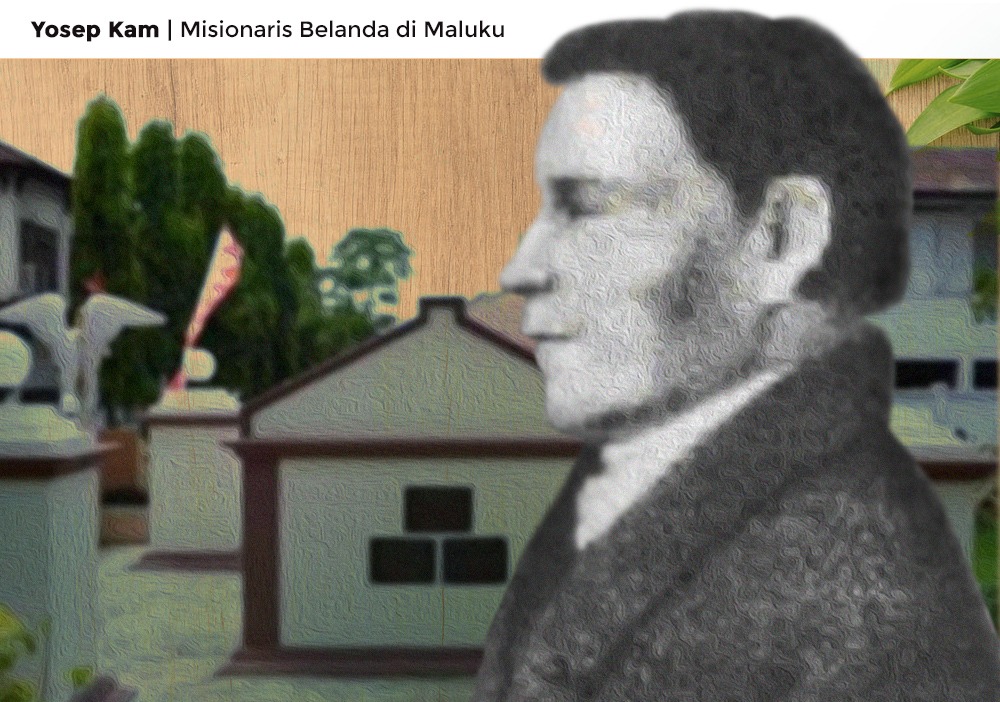
The preaching of the Gospel to the people of the Moluccas had already been done by Francis Xaverius in the 15th century. And then Nederlandsch Zendeling GenootschapJoseph Kam was given the title Apostle of Maluku by the Christian community in Maluku.
In his humble home in Hertogenbosch, Netherlands, Joseph Kam was born in September 1769. Joseph was the son of Joost Kam and Anna Margarethazoek who married on 28 August 1766. Hertogenbosch in the present day is included in the province of North Brabant which directly borders Belgium. Joseph's parents were from the middle class and worked as barbers, physicians, wigmakers and tanners. Joseph Kam was the second of five children, all born in Hertogenbosch. His brother, Samuel Kam, was a pastor who was awarded two silver medals for his writings published in 1801 and 1804. Samuel Kam also founded the Zendeling Instituutat his home and participated in correcting the Malay Bible. His three sisters, Anna Cornelia Kam, Maria Magdalena Kam, and Josina Kam, were all baptised in the Grote Kerk Den Bosch.
The dynamics of Joseph Kam's preparation period
With love and good spiritual education his parents raised them. His father, Joost Kam took part in the fellowship of Herrnhutdespite being a registered member of the Grote Kerk Den Bosch in Hertogenbosch. It was in this fellowship that Joseph was taught from a young age about brotherly love, the preaching of peace, and the call to evangelise the Gentiles. His obedience to Christ and love for preaching gradually came to life in his heart. Joseph completed his basic education well and did not immediately go back to school because his father needed him to help in his leather trading business. Joseph faithfully followed his father's will. In his youth he learnt a lot from his father about how to run a business. For Joseph it was probably a realistic choice to pursue his father's tannery business as his labour was needed to provide for his parents and younger sister. His desire to share the good news was alive in his heart and he always believed God would open the way for him. Joseph put his life's path through the guidance of the God he believed in.
The French Revolution of 1789 affected life across Europe, with tensions everywhere including in Hertogenbosch. The leather trade temporarily experienced a decline in demand and was predicted to close due to bankruptcy. During the French siege of Hertogenbosch in 1794, his father sent Joseph out of town before the siege. When he was at the gate and about to head to Utrech Joseph made a U-turn. Calmly and bravely he made his way back, hiding secretly among the besieging French troops, spending the night under an army train, and sneaking in when the fortress surrendered. Shortly after the revolution, his parents died in 1802 and shortly after that the tannery ceased operations as well. Joseph thought it might be a good time for him to join the sending mission, but his desire had to be held back because his sister was in failing health and needed financial and intensive care. Joseph got a job as an errand boy at the National Court in The Hague. Joseph invited his two sisters to move to the city with him. He met Alida van Epen in the city and decided to marry her in June 1804. Alida van Epen was the daughter of Gerrit van Epen, a local pastor. Joseph was not long in embracing the happiness of his marriage. Shortly after the birth of her daughter, Alida va Epen's health deteriorated and she died two months later. His daughter was then taken in by a close relative of his brother, Rev Samuel Kam, and lovingly brought up at Berkel Pastori. Joseph moved to Amsterdam and soon lost his job. His daughter also died of a seizure the night before Joseph was to visit her. When he had prepared for this sad news, he received it very calmly, and then said: “I am now studying God's will and ways. I want to be a missionary.
Joseph offered to take part in mission work and joined the NZG. Joseph travelled to Rotterdam in April 1811 to study as part of his preparation to become an evangelist. He was not alone, for three years Joseph studied with Gottlob Bruckner and Johann Christoffel Supper. They were taught theological knowledge, but also science, general history, drawing and musical knowledge. Four months later war broke out again, the French regained control of the Netherlands. The NZG was also experiencing financial difficulties at the time so it was not easy to send Joseph to evangelise. Joseph then met again with the Hernnhut congregation who did have the power to send him to become an evangelist. Together with two friends Bruckner and Supper continued their educational preparation in Zeist, Utrecht on 28 September 1811. Two years later Joseph travelled to London for his examinations at the London Missionary Society (LMS), an evangelical organisation founded by Anglicans, Congregationalists, Presbyterians and Wesleyans influenced by the spirit of pietism. Joseph passed and was ordained as a minister on Sunday 21 November 1813.
In the beginning Ambon
Maluku in the past was known as a region rich in spices and abundant marine products. The Dutch during the colonial period were even willing to exchange the island of Manhattan, which is now a metropolitan city, for the island of Run, which is only 600 hectares but rich in nutmeg. Maluku was administratively called "Gubernemen Maluku" during the colonial period and its territory was much larger than the current Maluku province, ranging from Papua to North Sulawesi. Joseph Kam, who travelled by ship from Jakarta, had a new and refreshing experience. Even though the journey was long and tiring and even seasick, it did not discourage him from setting foot in Ambon, which became the centre of the city in Maluku.
Since 1794 the city of Ambon has never had a permanent pastor to serve its congregation. An even sadder fact was that in other places in the neighbourhood such as Saparua, Banda, Ternate and Sangir the congregation never received ecclesiastical services. Holy communion is no longer celebrated, sidi confirmation and ecclesiastical marriage blessings can no longer take place. Only the school teacher who doubles as a church teacher faithfully serves the families in the small community. Their diligent Christianity was only an outward Christianity. Joseph Kam had to see this reality, a big job awaited him. With the great zeal that had become his trademark he immediately threw himself into his work.
The first thing he did was to form a special group for anyone who wanted to learn catechism in his home and be able to take Holy Communion. Then for the adults who gave themselves up for baptism Joseph Kam also formed a special service every week. Joseph took great care to ensure that all who came were well served. As part of his efforts to raise funds for his ministry Joseph established a prayer meeting every first Monday of the month. Dutch rulers and officers took part in these meetings and gave generous love offerings.
Good literacy was also not lost on Joseph so that the spiritual nurturing and knowledge of the faith of the Ambon people could be maintained. Joseph was diligent in writing to and liaising with the rulers so that there would be an institution that could fulfil the spiritual reading needs of the people there. An independent Bible Institute was established. A printing press was also established so that it could print the New Testament Bible with the addition of the Book of Psalms in Malay.
First Ambon and then Joseph visited other islands. In late 1815 he visited congregations in Haruku, South Seram and Saparua. Services such as serving communion, baptising and preaching were routinely carried out by Joseph. Later in 1816 he crossed to Boano Island and Manipa Island. In the favourable season for sailing the seas Joseph made visits outside Ambon. His good endurance and seaworthiness were probably inherited from his grandfather Diogo Cam, a Portuguese explorer of the late 15th century. He was also 47 years old at the time but that did not diminish his excitement and courage in the face of the fierce waves of the ocean.
During his travels to the villages Joseph Kam often encountered the low quality of education. This was evident in the number of students who could read but did not understand what they were reading, and the lack of educators who had the heart to serve the bumiputera children. Joseph Kam was therefore motivated to train native teachers, and did everything in his power to bring in Zendelings from the Netherlands. He gave up his yard to educate gospel teachers who could help his vast ministry.
Joseph Kam married again in 1815 to Sara Timmermen. They had two sons, Izaak Joseph Kam and Joseph Karel Kam, both born in Ambon. One of his sons Joseph Karel Kam followed in Joseph's footsteps by becoming a pastor and served at the Blenduk Church in Semarang in 1866.
After marriage Joseph continued his ministry by making a long-term commitment to the congregation in Ambon by building a church under his management and funding it partly from his assets. Not only that, his love for church music led him to import an organ from the Netherlands. The printing and binding of books that he pioneered also experienced rapid development, especially small writings that were useful and faith-building.
Joseph Kam is also open to working with Nederlands Bijbelgenootschap(NBG) or the Netherlands Bible Society as his most ardent supporter and collaborator. It was with great excitement that he soon joined when the activities of the NBG began to expand. Joseph rendered important services by distributing German-Dutch Bibles, especially the Malay Bibles in Latin, as well as those in Arabic. His main work of ministering to the congregation in Ambon and his other work of distributing Bibles went hand in hand.
The end of his life and ministry.
On 24 March 1833 Joseph travelled and visited many islands for three months and only returned from Banda on 14 July 1833 due to a serious illness.On the morning of the fourth day after his return from his journey Joseph died in the arms of his friend and successor Rev Gericke at the age of 63 years and 10 months. His funeral was attended by a crowd that exceeded the capacity of the Church, showing how much he was loved; hundreds of people flocked to honour Joseph one last time.