A major ideological upheaval swept through the Christian community in the Netherlands when the Indonesian revolution broke out. Many churchgoers wondered why one of their theological pillars had actually changed course and was defending the rights of the indigenous people. Cynical accusations began to be levelled at him. Amidst those exhausting geopolitical tensions, the theologian refused to remain neutral. He viewed the Gospel’s mandate not as a passive rule of faith, but as a courageous calling to speak out for structural justice, even when his voice had to challenge the prevailing currents of his own nation.
That man was Johannes Verkuyl. He was born on 16 January 1908 in Nieuw Vennep, Haarlemmermeer, the Netherlands. Verkuyl grew up as the fifth of ten siblings. His large family were farmers accustomed to hard work, frugal living, and a love of reading. The rural environment of that densely populated reclaimed land shaped the young Verkuyl’s understanding of the importance of shared responsibility, solidarity, and empathy for others. At the family dinner table, his mother would often recount stories of global mission work, sowing the seeds of a longing that would later shape the course of Verkuyl’s life.
Shaping Oneself for a Wider World
The young Verkuyl’s theological calling demanded extraordinary perseverance. Whilst studying at Het Christelijk Lyceum in Haarlem, he chose the classical stream Gymnasium in order to master Latin, Hebrew, and Greek, alongside four other modern languages. His wide-ranging reading interests led him to Vrije Universiteit in Amsterdam between 1927 and 1932. It was at this independent university that his intellectual acumen was honed. Verkuyl began to grow restless and to criticise the narrow-minded and exclusive attitudes that often plagued his own church synod, which he considered to be turning a blind eye to the realities of the real world.
A year after formalising his marriage to Rie van den Heuvel, in 1935 Verkuyl was appointed as a part-time student chaplain for young people of Asian origin in the Netherlands. This role later developed into a full-time ministry. In halls of residence and around lively discussion tables, he listened to sharp criticism and political aspirations from activists of the Indonesian Association (PI) and the Indonesian Christian Youth Movement (Perki). These emotionally charged encounters turned his missionary paradigm on its head: the proclamation of the Gospel must not stop at personal conversion, but must become a political-ecumenical mission (missio politica oecumenica) that champions structural justice for oppressed nations.
Through the Night Towards the Land of Hope
In late December 1939, amidst a global situation growing increasingly tense under the shadow of the Second World War, Verkuyl set off with his wife and three children, journeying through the darkness towards the port of Genoa, Italy. He had been commissioned by his church to serve as a missionary pastor in Indonesia. Before departing, he had managed to complete his doctoral examination with the distinction of cum laude under the supervision of Prof. J.H. Bavinck. Upon arrival at Tanjung Priok Harbour in January 1940. From Jakarta, Verkuyl and his family travelled to Purwokerto to serve as “congregational assistants” in the Banyumas district. He deliberately chose the term “assistant” to emphasise equality: the local congregation were mature and autonomous partners, not colonial subordinates.
In Purwokerto, Verkuyl grappled with a bitter reality: the congregation’s low interest in reading and the scarcity of available Christian literature. For him, books were a crucial tool for nurturing faith. So, late into the night, by the flickering light of a kerosene lamp, he began to write with a copper pen dipped into an ink bottle. However, the storm of war soon interrupted his ministry. When the Japanese army occupied Indonesia, Verkuyl was thrown into prison in Pekalongan, whilst his wife, who had just given birth, and their four young children were detained and taken to a prisoner-of-war camp in Bandung.
Diplomacy on a Rusty Bicycle
The dawn of independence in 1945 reunited the Verkuyl family, who had been separated in Jakarta. They found shelter in the meeting hall of the Indonesian Christian Church (GKI) at 28 Kwitang Street, Central Jakarta. Verkuyl took up his new post as head of the Dutch Gospel mission. He served the congregation diligently, despite having nothing but a dilapidated bicycle. Amidst the turmoil of the revolutionary war, he chose the path of peace. Verkuyl crossed the regional border, entering the territory of the Republic in Yogyakarta to negotiate with President Soekarno and Vice-President Hatta.
Not only that, he travelled back and forth to the Netherlands to persuade the church, the public and even Queen Wilhelmina to recognise Indonesia’s sovereignty. The academic pamphlet he wrote, De achtergrond van het Indonesische vraagstuk—or “The Background to the Indonesian Question”—sparked a storm of criticism in his own country because it radically defended Indonesia’s independence. In the Netherlands he was branded a traitor; in Indonesia he was at one point suspected of being an agent of the colonial powers’ religion. However, in Verkuyl’s view, because his commitment was deeply rooted in missio Dei—the Gospel must champion reconciliation.
His monumental contribution to the church in Indonesia came to fruition when he initiated the formation of the Emergency Reading Commission in October 1946, which later developed into the Gunung Mulia Christian Publishing Board (BPK) Gunung Mulia at 22 Kwitang Street. It was here that Verkuyl devoted his energies from 1946 to 1963 as the architect of the theological direction of the publishing house. He was a hard worker who detested idleness. When the publisher’s funds were insufficient to print a book, Verkuyl would secretly hand over an envelope marked nomen nescio (servant of God)—which turned out to be his own wife’s household money.
Silence Behind the Splendour of the Ministry Stage
However, great ministry often demands an extremely high personal cost. Johannes Verkuyl’s personal life bears the scars of family sacrifices that are rarely brought to public attention. His radical choice to blur the boundaries between private life and public service has had a severe impact on his family. As soon as his children reached primary school age, they had to be sent back to the Netherlands one by one in order to receive an adequate education.
Repeated geographical separations shattered the natural emotional bonds between siblings. In an era when telephones did not yet exist and airmail took weeks to arrive, both children and parents had to endure the pain of profound longing. His wife, Rie, chose to yield and fed him spoonful by spoonful whilst Verkuyl was absorbed in typing his manuscript, burying her own inner pain as a mother. “We’re proud that our father was famous, but we didn’t really know him,” one of his sons admitted honestly. In his later years, Verkuyl acknowledged with deep regret that whilst he was busy ministering to thousands of congregants across the seas, his own children were actually longing forhis presence as a father.
The Strong Character of an Ordinary Man
Verkuyl was by no means a flawless humanist; historical records show him to have been an ordinary man with a dynamic, explosive temperament, and at times even defensive and confrontational when he felt the purity of his organisation or theology was under threat. This strong-willed nature came to the fore in 1965 when he served as General Secretary of the Dutch Missionary Council (NZR). Upon hearing of a group of students’ plan to include a scholarly article by Prof. W.F. Wertheim, which espoused Marxist views, in a collection of writings on Indonesia, Verkuyl reacted with unbridled fury.
Driven by a pragmatic fear that the reputation of the missionary organisation would be tarnished in the eyes of the Indonesian public following the political events of 1965, he initially labelled Wertheim an ideological enemy a priori. Although he eventually softened his stance after realising that the article dealt purely with the plight of the Chinese minority, this incident revealed another side to the ecumenical theologian: under intense pressure, he too could become trapped in rigid suspicion and intolerance—precisely the same attitudes he had criticised in the church during his youth.
Echoing Until the End of His Life
Upon his return to the Netherlands at the end of 1962, Verkuyl was appointed professor of missiology at the Vrije Universiteit Amsterdam. His seminal work, Inleiding in de Nieuwe Zendingswetenschap (1975)—which translates as ‘An Introduction to the New Science of Missiology’—reaffirmed that the proclamation of the Gospel is an act of God Himself (missio Dei), in which the relationship between the Western Church and the churches of the Global South must be one of equal partnership. In recognition of his services which transcended national borders, the Government of the Republic of Indonesia awarded him the Bintang Jasa Pratama on 18 January 1977.
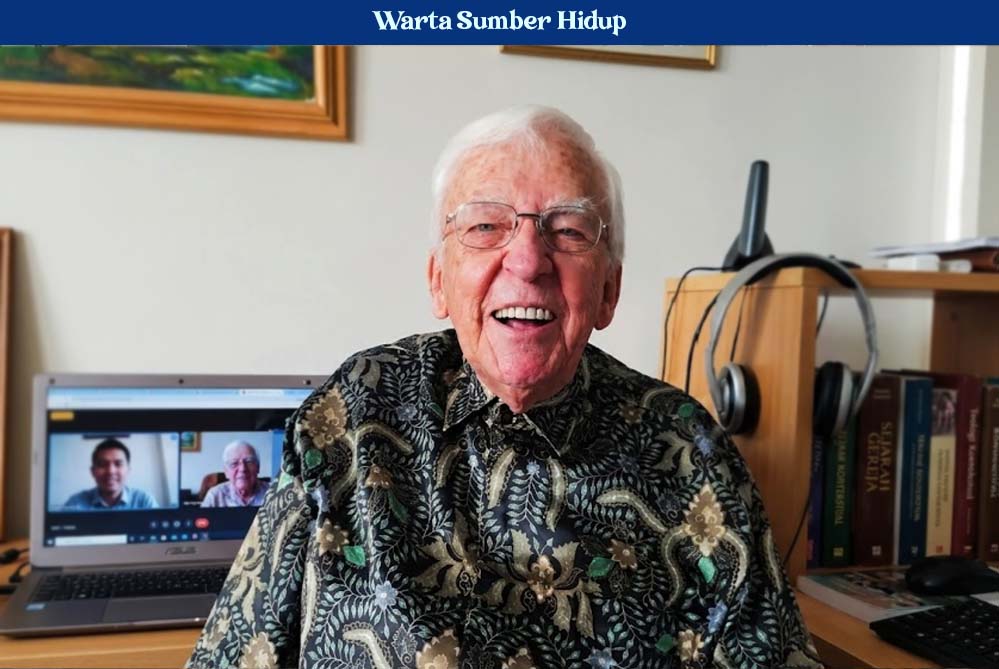
As time went by, the theologian entered the autumn of his life. In a reflection on his old age, Verkuyl once remarked meaningfully: “When we are young, almost everything is marked by the word ‘already’. We can already walk, can already speak, can already write, and so on. But as we grow old, almost everything shifts to the word ‘still’. We can still see, can still hear, can still walk, can still speak…’ The word ‘still’ truly came to life in the remaining years of his life. As his physical body was increasingly ravaged by diabetes mellitus, severe hearing loss, and eventually blindness in his left eye, his spirit never wavered. Guided by the meticulous care of Cora van Hilten, the second wife he married following Rie’s passing, Verkuyl continued to write until he produced his spiritual testament, De kern van het christelijk geloof (1992), a profound work exploring the “Core of the Christian Faith”.
These fond memories of Verkuyl’s sharp mind in his twilight years have also been immortalised by Andar Ismail in his reflective book, Selamat Berbuah. Andar recalls a precious moment in 1995, when he and Peter Latuihamallo were on a three-month assignment in Leiden, the Netherlands. At that time, they met Verkuyl, who was already confined to a wheelchair. His body was growing increasingly frail; even to simply hold a pen, his fingers needed to be patiently guided by his wife. Yet, despite these physical limitations, Andar witnessed first-hand how the elderly theologian’s train of thought still flowed clearly, coherently and fluently.
When Johannes Verkuyl breathed his last on 27 January 2001 at the age of 93, he left behind a lasting legacy of thought for the modern church: that true faith must not be passive.
Rev. Sularso Sopater described Verkuyl as a highly influential and inspiring figure. Meanwhile, Rev. P.D. Latuihamallo described him as a man who remained consistent throughout his life. Over a period of 45 years (1946–1990), no fewer than 30 of Verkuyl’s books were published by BPK Gunung Mulia. Some of these are still in use today by churches in Indonesia for theological education and the discipleship of church members.
Like a grain of wheat that cast itself down in the back garden of the old house at Kwitang 22 in October 1946, Verkuyl chose to ‘die’ to his own interests, so that from him might spring forth a bountiful harvest of service for the Church of the Lord throughout Indonesia. (per)