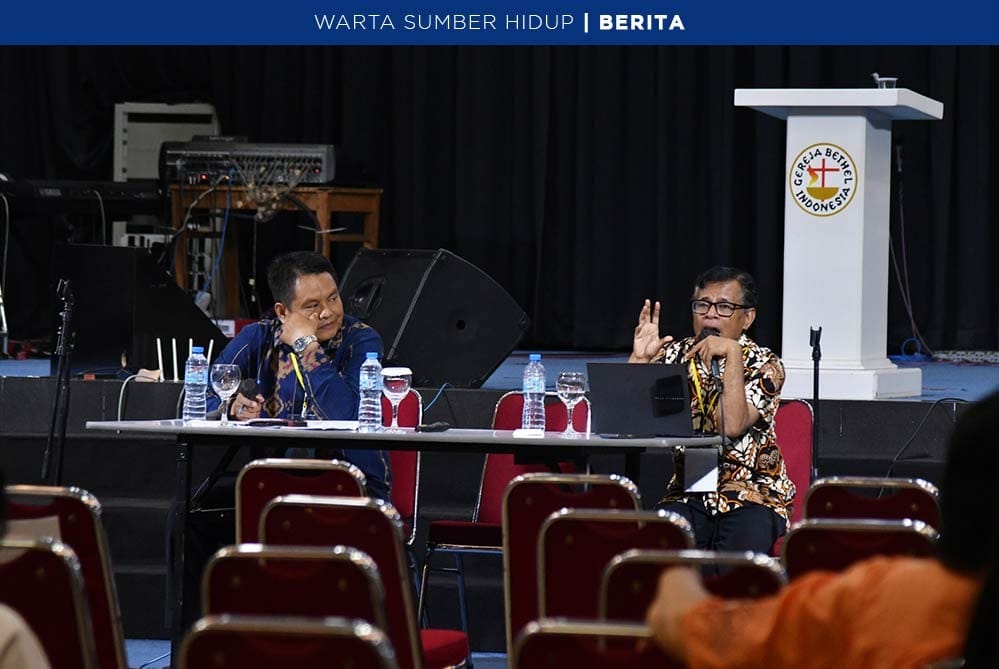
Speaker: Rev. Asigor P. Sitanggang, Th.D.
Editor: Juan Nicohlas
When addressing and discussing occultism and exorcism, there are two diametrically opposed attitudes. The first attitude is to reject the existence of such experiences. Occultism and exorcism are deemed irrational, regarded as superstition, or viewed as symptoms of psychological disorders. The second stance is to accept that these experiences exist and are real. Generally speaking, churches also practise exorcism or the casting out of demons.
Churches that practise exorcism include the Orthodox Church, the Roman Catholic Church, the Lutheran Church in its early days, Methodist, Evangelical, Pentecostal and Charismatic churches. Unlike the churches already mentioned, Calvinist churches do not practise exorcism; this is thought to be because John Calvin himself was strongly opposed to the sacralisation of certain materials or objects.
Basic Principles
Generally speaking, theology is built upon critical and scientific theological theories and principles. Experience is not considered a significant aspect in developing theological understanding. In addition to Sola Gracia, Sola Fidei and Sola Scriptura, Martin Luther, in his book Tischrede, also wrote about Sola Experientia. Sola Experientia means that experience plays an important role in theology.
René Descartes, a French philosopher, was one of the pioneers of Western rationalism. René’s ideas are known as Cartesian, that is, ideas centred on the mind. According to him, human existence depends on the mind. His famous saying is “I think, therefore I am” or, in Indonesian, “Aku berpikir, maka aku ada”. In short, according to René, human existence is determined by the mind and its capacity for thought. If a person ceases to think, then in essence they cease to be human.
Some Westerners do not believe in divine concepts such as God, angels, and evil spirits, including concepts such as the occult and exorcism. However, others choose to believe in the divine. They pray and believe in Allah, but in their daily lives they expect everything to be governed and explained by science and technology. Therefore, when events such as possession by evil spirits occur, for them the solution lies in modern medicine and psychology.
Paul G. Hiebert, an anthropologist, argues that Cartesian thought led to a dualism of realms: the spiritual and the physical. Secularism has also caused Western society to lean more towards the physical world. The Church and its practices in the West have also been influenced by this secularist outlook, with the result that many Western Churches believe that spiritual gifts have ceased.
Materialism
Materialism refers to a focus on the material world, as opposed to intellectual or spiritual concepts. On the other hand, materialism can also be seen as a theory which states that physical matter is the only thing that exists in this world. Thus, everything in this world is matter. Nothing is of an intellectual or spiritual nature; thoughts and feelings are merely chemical reactions occurring within the human brain. Materialism asserts that, in life, material progress is the highest form of success and the greatest value that can be attained.
This doctrine of materialism is highly dominant in the patterns and daily lifeof Western society. Consequently, materialism firmly asserts that the existence of everything can only be explained in material terms, without any need to consider the spirit or consciousness. Owing to the prevalence of materialism in the Western world, the concept of sin is not something Western society recognises; for them, what matters most are the concepts of morality, ethics and civil law. Spirits and angels are merely part of folklore for Western society.
OCCULTISM AS A SCIENCE
Occultism derives from the Latin word “occultus”, which means secret and hidden. Therefore, occultism is defined as the knowledge of hidden or paranormal phenomena. As a discipline, occultism is the study of practices such as: magic, shamanism, mesmerism, alchemy, extrasensory perception, astrology, spiritualism, divination and the use of mediumistic objects, such as tarot cards, Ouija boards, and so on.
According to Alan Kardec, a practitioner of Spiritism, Spiritism is the study of the nature, origin and ultimate purpose of spirits, as well as their relationship with the physical world. In Spiritism, the spirits of the dead are believed to be capable of reincarnation or to still be present in the world. Spiritualists view the afterlife as a far more advanced realm than the world inhabited by humans.
For occultists, occultism is viewed as the study of the inner nature of objects. This stands in contrast to what is taught and learnt in science in general. Religion is closely linked to occultism, both as a practitioner and as an expeller.
Biblical Texts on Occultism
The word “spirit” appears a total of 488 times in the Indonesian Bible (TB): 141 times in the Old Testament and 347 times in the New Testament. The term &‘evil spirit’ appears 10 times in the Old Testament and 33 times in the New Testament. In the Old Testament, the term ‘evil spirit’ first appears in Deuteronomy 32:17.
However, an antagonistic spiritual figure had already appeared at the beginning of creation in the form of a serpent. In the Latin Bible, or Vulgate, the word for serpent is written as ‘serpens’rsquo’; in the Samaritan version, the word ‘kakash’ is used, which means ‘liar’ or ‘deceiver’. In ancient times, the serpent was a representation of &‘intelligence’ and ‘wisdom’. Over time, the snake acquired additional meanings and evolved into a character that is cunning, evil and deceitful. From a Jewish perspective, the snake is understood to be the Devil.
THE OLD TESTAMENT
In the Old Testament, the term “evil spirit” appears only eight times.
Deuteronomy 32:17 explicitly states that the ‘other gods’ referred to are in fact evil spirits.
In 1 Samuel 16, the account is given of the Spirit of God departing from Saul, and the departure of the Spirit of God being replaced by the presence of an evil spirit that tormented Saul. Verses 14–16 affirm that this evil spirit came from God. There are two perspectives on this matter. Firstly, it was indeed God who sent the evil spirit. Secondly, the evil spirit acted with God’s permission. Meanwhile, chapters 18 and 19 recount how David’s playing of the harp was able to temporarily drive away the evil spirit that was tormenting Saul.
Psalm 96 recounts the story of how the Israelites left the land of Egypt. The text also describes how the Israelites turned away from YHWH by mingling with other tribes and following their idols. The idols worshipped by these other tribes and by the Israelites were regarded as manifestations of evil spirits.
The Old Testament mentions the term ‘diviner’ 16 times. Generally, in Old Testament texts, diviners are depicted as having ties to evil spirits (Lev 19:31). Diviners are also said to merely boast about their prophecies (Isa 44:25). YHWH regards such practices as unclean and associated with idolatry, with the death penalty for those who practise them.
The word ‘sorcerer’ appears only once, namely in Ezekiel 13:18, which refers to female soothsayers with their amulet cords. The term “soothsayer” is considered to have the same meaning as “fortune-teller”, that is, a sorcerer or someone who consults spirits and seeks guidance from the dead.
The term “arwah” or &‘spirit summoner’ appears 22 times in the Bible. The practice of spirit summoning is, of course, forbidden by God as it is considered an abomination (Lev 19:31), and the punishment for those who practise it is death.
In 1 Samuel 28, there is an account of how Saul went to a medium at En-Dor and asked her to summon the spirit of Samuel. Interestingly, the spirit of Samuel subsequently appeared before the woman. To understand the theological significance of this story, there are two perspectives:
- Treating the narrative of the story as it is, without any specific theological judgement. Thus, the spirit appearing as Samuel is described simply as Samuel, even though it is in fact regarded as an evil spirit.
- Assuming that the spirit of a deceased person can indeed still be summoned.
Exegetes and the Church tend to favour the first view, as both the Old and New Testaments affirm that the realm of the dead is separate from the realm of the living, and the two are in no way connected.
The term “world of the dead” appears 68 times in the Old Testament. In these instances, the term describes how people who have died enter the realm of the dead. None of these texts state that people from the realm of the dead will or can return to the world of the living.
LUCIFER
In the Old Testament, the terms ‘Satan’ or ‘devil’ were not yet in use. In Isaiah 14:12, the narrative concerning the Morning Star or Son of the Dawn is often regarded as a representation of Satan; in English Bibles such as the King James Version (KJV), the term ‘Morning Star’ is translated as ‘Lucifer’.
Lucifer himself is a personification of the Morning Star that appears at dawn, which is in fact the planet Venus. The word ‘Lucifer’ derives from the Latin lux, meaning “light”, and ferre , meaning “to carry”. Thus, Lucifer can be understood as “the bringer of light”. In Christianity, Lucifer is often regarded as a demonic figure, whereas in Judaism itself the figure of Lucifer, as understood in the Christian tradition, is not recognised.
THE NEW TESTAMENT
In the Old Testament, discussions regarding evil spirits are relatively fewer in number compared to the New Testament. In the New Testament, evil spirits are described as being able to enter places of worship (Mark 1:23–26). It can therefore be concluded that places of worship themselves are not immune to the presence of evil spirits.
In addition to their primary task of preaching the Gospel, Jesus’ disciples were also given other tasks, such as casting out evil spirits (Mark 6:7; Matthew 10:1). The Gospel of Mark also recounts how evil spirits recognised Jesus as the Son of God.
The Gospel of Mark also contains many accounts of how evil spirits can enter and possess human bodies and take control of them. A possessed body may scream, experience convulsions, lose control of itself, and even be dragged about. Not only do they possess humans, but evil spirits are also depicted as being able to possess animals, as in the story of the evil spirits entering a herd of pigs.
In the New Testament, the devil is understood to be the leader of the angels who follow him, including demons and evil spirits (Matthew 25:41). The devil is also called Beelzebub and is referred to as the prince of demons (Mark 3:22).
In the Acts of the Apostles, evil spirits are also depicted as recognising the apostles, such as when they declared that they knew Jesus and Paul. The New Testament does not use the same terms as the Old Testament, such as seers, soothsayers or sorcerers. The New Testament focuses more directly on the crux of the matter, namely the devil and evil spirits.
PSYCHOLOGICAL CONDITIONS PRONE TO POSSESSION
According to research, individuals who are susceptible to possession usually share certain characteristics.
Firstly, individuals who experience symptoms of possession are generally those who hold spiritual beliefs regarding the afterlife or the spirit world. If a person does not believe in spirits, the likelihood of that individual experiencing possession is considered lower. Secondly, personality factors. Individuals who possess a vivid imagination, are easily suggestible, prone to anxiety, and emotional. Thirdly, situational factors. Certain situations can trigger imaginings and feelings similar to traumatic experiences a person has previously endured. Fourthly, health factors. Fatigue or illness can make a person more susceptible to possession. Given these factors, the phenomenon of possession is considered more likely to occur.
According to observations made by Rev. Asigor P Sitanggang, Th.D., around 90 per cent of phenomena related to evil spirits, ghosts and apparitions are not actually real. Often, these phenomena are merely the result of the imagination and strong suggestion.
William James stated that, regardless of whether spirits exist or not, evil spirits inevitably enter a person through a fractured soul. Every human being inevitably has a fracture within themselves. Therefore, the focus should be on healing that fracture.
Often, possession serves as a means of fulfilling certain unmet needs. As such, possession can be understood as a symptom whose underlying causes must be investigated to prevent its recurrence.
OCCULTISM IN INDONESIA
In Indonesia, the practice of shamanism can be found everywhere, as can cases of possession. On the other hand, someone experiencing withdrawal symptoms (sakau) or severe depression sometimes displays symptoms resembling those of a possessed person. Therefore, it is important to focus on the underlying cause, rather than merely on the symptoms.
CONCLUSION
The cultural and social context in Indonesia differs from that of Western societies. The Bible bears witness to the existence of the spiritual realm. Therefore, churches in Indonesia need to develop their own theological understanding of the occult and exorcism that is relevant to the cultural context and way of life of the local community, in response to the needs of their congregations.
CONCLUSION
When we see someone exhibiting symptoms of possession, we should not immediately assume that the person is possessed by an evil spirit. This is because such symptoms are very likely caused by psychological issues. Therefore, when an individual exhibits such symptoms, the congregation is expected to act as a support system, offering support and care until the individual has recovered.