Memra Project, Poigar, 12–14 November 2026
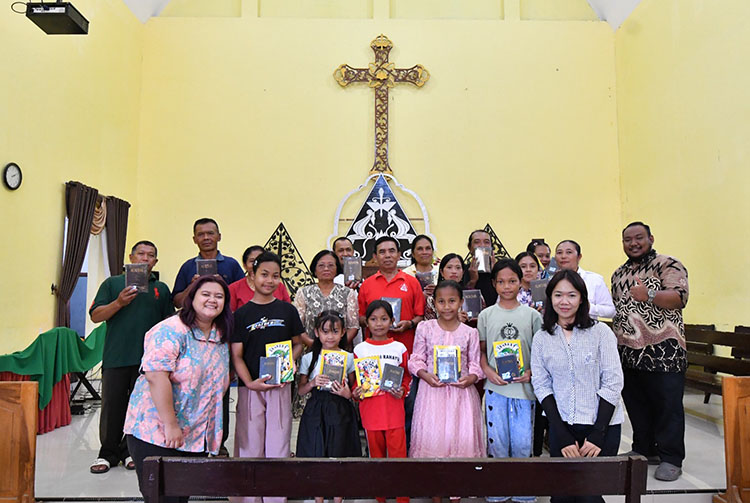
At 07.30 WITA, young people and youth leaders from various GMIBM congregations in Bolaang Mongondow had filled the church hall. The LAI Digital Literacy event, now known as the Memra (Media Education and Ministry for Relevance Advocacy) Project, was about to begin. The 138 registered participants, who turned out to represent a wide range of age groups, were clearly eager to gain new insights into LAI’s content creation.
At 08.00, the opening worship service finally began. Accompanied by a solo organist, the liturgist and singers performed worship songs with great reverence and joy. Although the equipment was quite simple, everyone continued to sing and praise the Lord with enthusiasm. Rev. Alri Momongan, S.Th., who delivered the sermon during the service, spoke about social awareness regarding current issues and the use of social media as a means of speaking the truth, which further fuelled the participants’ enthusiasm to get creative and start producing content.
At around 09.00 WITA, the service concluded and the session began with a discussion on how LAI understands and creates content. During the presentation, it was explained that content creation at LAI falls under the mandate of Bible Engagement—one of LAI’s initiatives to foster a deeper love for the Bible amongst the congregation. Consequently, when creating content, LAI must tailor it to the needs of the congregation.

After explaining the content creation and distribution process at length, Inay discussed the channels through which content is broadcast, one of which is via the website.
Once the LAI team’s session had concluded, it was time for the much-anticipated event: an introduction to the guest star, Ferlan Wongkar. Ferlan remains active as a social media influencer through his various posts. On this occasion, he explained how he got started and went on to gain a large following. Interestingly, Ferlan is an alumnus of the 2018 LAI Digital Literacy programme entitled From God To God. He recounted that from that programme, he received two blessings at once: firstly, a job as a videographer; and secondly, he found his soulmate. Instantly, the entire room cheered and applauded.
Following the introduction of the speakers and guest stars, the host, Kenia, invited participants to ask questions. Surprisingly, many of the questions were directed at Inay regarding the management of websites as a channel for content distribution.
Once the discussion session had finished, it was time for the hands-on content creation session. For this part of the programme, the participants had been divided into 11 groups, each comprising 8–10 people. Here, participants were introduced to the preparatory steps for video production. Thus, rather than immediately creating short videos, they first learnt about the planning process—from the background, objectives, benefits and target audience, right through to distribution and screening. This session was led by Hizkia Yosurandri and Ferlan Wongkar. In a separate class, Inay explained the fundamentals of visual communication design (VCD). She emphasised that understanding VCD is not merely about creating graphics, but rather about how the video’s message is conveyed through its entire visual composition.
The first day’s session concluded with each group giving a presentation. All participants were required to explain the background and planning behind their content creation.
The following day, Thursday 13 November 2026, the participants continued the workshop on filming, lighting and video editing with Hizkia and Ferlan. Meanwhile, Inay continued to guide the participants in the design class.
After lunch, at 13:00 WITA, the participants practised creating short video content lasting a maximum of 2 minutes as an implementation of the plans presented on the first day. From shooting, sound recording, to editing, they carried out these tasks around GMIBM Sion Wineru. Occasionally, the guest speakers helped and ensured they were following the correct steps in video production.
Finally, the second day concluded at 18:00 WITA. Participants were invited to have a meal and rest, although some groups continued working on their videos to be submitted on Friday, 14 November 2026 at 09.00 WITA.
By the end of the second day of the workshop, the participants not only understood how to edit videos and use cameras, but also grasped the reasons why they should create content.